Collin
Wittenstein
PhD Student @ MIT CCSE
About Me
Hi, my name is Collin. In my research, I use clever mathematics and clever coding to make PDE simulations go brrrr.
More practically, I work across the computational pipeline for solving partial differential equations. This means for example deriving structure-preserving numerical methods, implementing them and making sure everything runs fast on both CPUs and GPUs.
I'm a PhD student at MIT CCSE, advised by Alan Edelman in the Julia Lab. I studied at Johannes Gutenberg University Mainz, Germany, where I completed two master's degrees in Physics and Computational Sciences, building on my bachelor's degrees in Physics and Mathematics. As part of my master's, I spent eight months as a visiting student at MIT (Sep 2025–Apr 2026), working with Robert Metcalfe and Alan Edelman on GPU-accelerated simulations of geothermal well arrays for my thesis research.
One thing I really enjoy about my work is how varied the problems are. In the past couple years I've worked on weather simulations, the counterintuitive rattleback dynamics, water wave modeling, and now geothermal energy systems. Keeps things interesting.
Contact
Feel free to reach out to me: cwittens@mit.edu.
Publications
Research &
Projects
∇TGeothermal Well Simulations
Deep borehole heat exchangers extract geothermal energy by circulating fluid through closed-loop pipes that extend several kilometers into the Earth. This sounds nice, but simulating them is unfortunately not easy: you're dealing with multi-scale geometry where boreholes are centimeters wide but kilometers deep, and you need to simulate years to decades of operation to understand thermal performance. For arrays of multiple wells interacting thermally over these timescales, it was traditionally thought that a fully three-dimensional simulation of the arrays would be computationally unfeasible. Luckily for me I didn't know this before starting to work on the project.
So, I developed a GPU-accelerated three-dimensional model simulating geothermal well arrays. The key innovation is an operator splitting strategy tailored to the problem's physics. Vertical diffusion gets stabilized explicit Runge-Kutta-Chebyshev methods, horizontal diffusion gets ADI schemes, advection gets semi-Lagrangian treatment. Each operator handled by whatever works best for it - sounds obvious in hindsight, but figuring out this combination took a while.
I released this as the open-source Julia package GeothermalWells.jl, using vendor-agnostic GPU kernels that run on both NVIDIA and AMD hardware. Full three-dimensional simulations of multi-well arrays over decades can now run on a single GPU, enabling systematic design space exploration and optimization of geothermal well systems.
This became my master's thesis, supervised by Prof. Dr. Hendrik Ranocha and Prof. Dr. Friederike Schmid, and done in collaboration with Prof. Dr. Alan Edelman and Robert Metcalfe at MIT – who also wrote the foreword.
∂ηWater Wave Simulations
I worked on dispersive shallow water equations. The following visualization shows the evolution of a wave over Gaussian bathymetry, using the hyperbolic approximation of the Serre–Green–Naghdi equations in two dimensions. The simulation employs a new energy-conserving semi-discretization that maintains physical properties over long time integrations. I also worked quite a bit on DispersiveShallowWater.jl, a Julia package that implements structure-preserving numerical methods for one-dimensional dispersive shallow water models. Supervised by Prof. Dr. Hendrik Ranocha.
ωRattleback Simulation
For my (maths) bachelor thesis, I simulated the movement of the rattleback (German: Wackelstein), a semi-ellipsoid with an inhomogeneous mass distribution that exhibits quite counterintuitive behavior: it can spontaneously reverse its spinning direction. This phenomenon defies intuition but follows directly from the solutions of its equations of motion. Supervised by Prof. Dr. Hendrik Ranocha and Univ.-Prof. Dr. Elmar Schömer.
For this work, I received the best bachelor's thesis in mathematics of the year award.
Open Source
Contributions
I like to contribute to the Julia open-source community. Here are some of my contributions to other people's repos.
Curriculum Vitae
For my full CV as PDF:
View PDFAcademic Background
PhD Student, MIT CCSE (Sep 2026–present)
Advisor: Prof. Alan Edelman, Julia Lab (CSAIL)
Visiting Student, MIT (Sep 2025–Apr 2026)
Thesis research at CSAIL with Prof. Alan Edelman and Turing laureate Robert Metcalfe
Johannes Gutenberg University Mainz (Oct 2019–Jul 2026)
- M.Sc. Computational Sciences — Grade 1.0 (US GPA: 4.0)
- M.Sc. Physics — Grade 1.1 (US GPA: 3.9)
- B.Sc. Mathematics — Grade 1.2 (US GPA: 3.8)
- B.Sc. Physics — Grade 1.3 (US GPA: 3.7)
Workshops & Talks
- Hands-on with Julia for HPC on GPUs (Aug 2026) — Three-hour workshop at JuliaCon 2026, co-taught with Ludovic Räss, Ivan Utkin, and Boris Kaus
- GeothermalWells.jl: GPU-Accelerated 3D Simulation of Deep Borehole Heat Exchanger Arrays (Aug 2026) — Talk and poster at JuliaCon 2026, Mainz
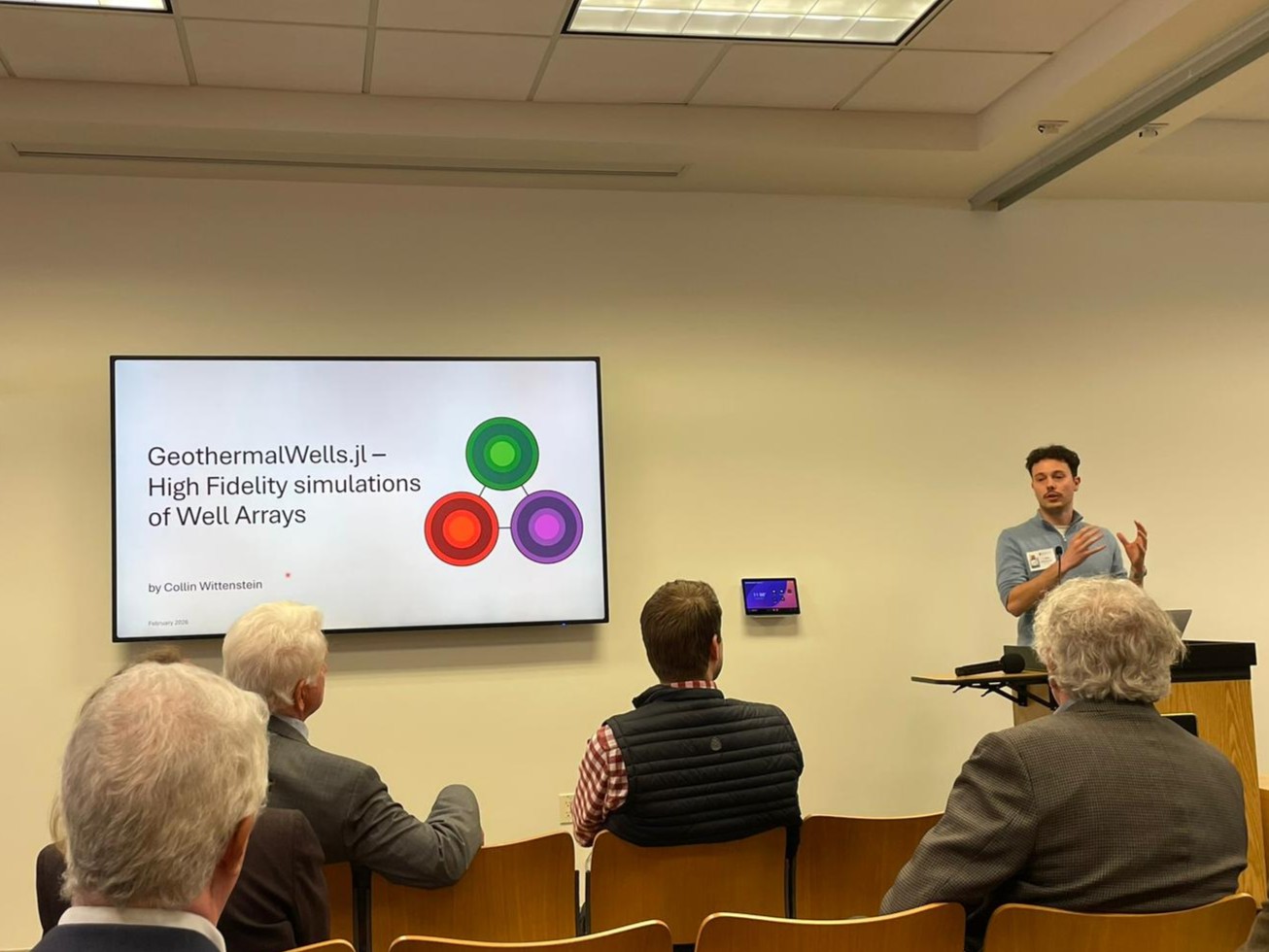
- GeothermalWells.jl – High Fidelity Simulations of Well Arrays (Feb 2026) — Talk at the 51st Stanford Geothermal Workshop
- A Full Three-Dimensional GPU-Accelerated Model for DBHEs Enabling Simulation of Well Arrays (Mar 2026) — Poster at the MIT Energy Initiative Spring Symposium
Teaching
Teaching Assistant, Theoretical Physics (2021–2023)
- Quantum Mechanics (Summer 2023)
- Classical Mechanics (Summer 2022)
- Special Relativity and Electrodynamics (Winter 2021)
Awards & Honors
- CCSE College of Computing Graduate Fellowship, MIT (2026–2027) — Awarded to incoming PhD students for outstanding academic record and research potential
- Young Researcher, 13th Heidelberg Laureate Forum (Sep 2026) — One of 200 young researchers selected worldwide to meet Turing Award, Abel Prize, and Fields Medal laureates; led a panel discussion on How to Choose a PhD Topic in the Age of AI
- Best Thesis of the Year 2024, Mathematics — Department of Mathematics, JGU Mainz
- Deutschlandstipendium (2020–2026) — Five-time recipient of Germany's merit-based scholarship; now sponsoring one myself at JGU Mainz (JGU Magazine article)
- Environmental Service Award (2022) — City of Mainz
- DPG Award for Excellence in Physics (2018) — German Physical Society
Service & Leadership
- Student Representative, Examination Board (2024–2026) — Sole student rep for Computational Sciences, JGU Mainz
- Co-founder & Vice Chair, Klimaliste Rhineland-Palatinate (2020–2021) — Led climate organization with 200+ members; featured in Teen Vogue and The Guardian
- Organizer, Fridays for Future (2019–2021) — Organized climate protests with up to 12,000 participants
In the Wild
Every now and then I leave the terminal and talk to people. Here is where that happened.
Episode #272 of the Auch Interessant podcast. We talk about geothermal energy, simulating it on GPUs, and what it is like to do research at MIT.
Open on YouTubeFrom Deutschlandstipendium recipient to sponsoring one myself: a portrait by my alma mater about my path from Mainz to MIT.
Read article Teen Vogue · Interview · 2021An old interview with me as one of the cofounders of Klimaliste RLP, a regional climate party that pushed for politics in line with the 1.5°C target.
Read articleReading
I enjoy reading. I feel like social media kills your attention span, whereas books do the opposite.
And, is there anything nicer than recommending a book and having someone not only read, but actually enjoy
it??
Anyway, here are some of my book recs: